
Searching the New Orleans Court Docket
Court records in New Orleans follow several separate paths. A traffic ticket or municipal summons belongs to Municipal and Traffic Court. A state criminal case runs through Criminal District Court and its Clerk Connect system. Civil District Court holds the parish-wide civil files, plus domestic, probate, and succession records. You reach those through the Civil Clerk and Remote Access. Smaller civil disputes may land in First City Court on the East Bank. Others go to Second City Court in Algiers. Juvenile files stay confidential. They have no place in an ordinary public name search.
Use the case number if it is printed on your court paper. No number? Then work with the search fields the owning court publishes. Municipal and Traffic offers Case Number, Last Name, First Name, and Date of Birth. Civil Remote Access goes deeper with an account-based search. Clerk Connect takes a defendant name or case number for criminal inquiries.
- Match the notice to the named New Orleans court.
- Copy the case or citation number exactly.
- Use that court's official portal or clerk channel.
- Read the latest date and status rather than an older entry.
- Confirm an imminent setting with the court or clerk.
New Orleans Court Portal Choices
No single New Orleans lookup covers everything. The city splits its portals by court. Municipal and Traffic Court runs a public search. It is free but limited to that court's cases. Civil District Court offers Remote Access, which requires an account. It opens case information, pleadings, and document workflows. For criminal matters, the City guide sends users to Clerk Connect. That comes after account setup and selection of the Orleans criminal inquiry product.
| New Orleans case | Start here | Search limit |
|---|---|---|
| Municipal or traffic | traffic.nola.gov/search | Municipal and Traffic cases only; pre-2002 cases require direct contact. |
| State criminal | Clerk Connect | Transition from Docket Master; printing may cost. |
| Civil district | Civil Remote Access | Subscription, escrow, and historical coverage vary. |
| City court civil | First or Second City Court clerk | No general public portal found in the reviewed sources. |
New Orleans Municipal Court Basics
Municipal and Traffic Court handles city ordinances, traffic cases, and municipal misdemeanor summonses in New Orleans. Its current official site lists 727 South Broad Street, New Orleans, Louisiana 70119. Public hours are 8 a.m. to 4 p.m., and the phone number is (504) 658-8500. The site links to case search, payment, penalties, records, tickets, forms, and court information. Those services sit together, but that does not mean every step finishes on one page.
Camera and parking tickets are a different story. The court says plainly that it does not handle them. They may look like traffic notices. Yet the New Orleans court docket only covers this court's own cases. Start with the court printed on the paper. The neighborhood where an officer wrote the citation does not decide it.
New Orleans Court Addresses
Knowing which court you need matters more than the street address. Municipal and Traffic Court now sits on South Broad. First City Court is at 421 Loyola Avenue, Room 201. The Civil Clerk and Civil District Court records occupy Room 402 in the same building. Second City Court sits at 225 Morgan Street, Room 206. Criminal District Court is at 2700 Tulane Avenue. One New Orleans matter can touch several of these. Each is a separate records route.
Older City material gives 1601 Perdido Street for Municipal and Traffic Court. The current court website says 727 South Broad. Anyone holding an older citation should call the current court number before making a trip. The mismatch is a reason to verify, not proof that two counters are open.
Court Dates and Settings in New Orleans
A New Orleans setting can surface in several places. Look for a portal event history. Check a daily docket, a court calendar, an assigned section's schedule, or a clerk's confirmation. A signed order beats a stale portal line every time. So does direct word from the court. Criminal Court section pages often post daily dockets and current notices. Civil hearings get set by the assigned division or section. A Municipal and Traffic citation prints the first appearance date right on the paper.
| Date | The latest date associated with the New Orleans setting. |
|---|---|
| Time | The docket call or hearing time shown by the court. |
| Court or section | The specific New Orleans court, division, or section handling the event. |
| Setting type | Examples include first appearance, motion hearing, trial, status conference, or sentencing. |
| Status | Look for a later reset, continuance, or order before relying on an older entry. |
A motion to continue is only a request until the court grants it. When travel or your appearance turns on a New Orleans court date, call with the case number in hand.
New Orleans Court Calendar Checks
New Orleans calendars are court-specific, so check the right one. Criminal Court posts current news covering closures, weather, and remote-session notices. It also offers a separate holiday calendar. Municipal and Traffic Court publishes a holiday schedule too. A closure notice can change how you attend. Read it alongside the case's own docket entry and whatever the court directs.
Criminal Magistrate Court handles early appearances and bonds rather than serving as a citywide calendar. Its schedule lists weekday sessions at 9:30 a.m. and 3:00 p.m. Weekends and holidays get a 3:00 p.m. session. For one specific date, the individual New Orleans case record still beats every calendar.
Traffic Tickets in New Orleans
A New Orleans Municipal and Traffic Court ticket search works best with the case number. If that fails, the portal accepts the exact last name, first name, and date of birth printed on the notice. It covers Municipal and Traffic Court only. The court itself tells people with cases filed before 2002 to make contact directly. One caution applies here. A portal result shows docket information, not a certified record. Treat it as a starting point, not the final document.
The penalties page puts the first appearance, or arraignment date, right on the ticket. That date is a hard deadline. Pay the ticket or plead not guilty by then. The City adds that anyone contesting a traffic ticket, whether the person or a licensed attorney, must request a trial date in person on or before the first appearance. A misdemeanor summons works differently; it cannot be paid before first appearance and sentencing. For ticket and record details across Orleans Parish, see the Orleans Parish traffic tickets page.
New Orleans Traffic Boundaries
"Traffic" is not one tidy New Orleans record category. Municipal and Traffic Court keeps its own search and payment routes. Clerk Connect carries criminal and traffic inquiry labels through the criminal-record transition. Camera and parking notices sit outside the current Municipal and Traffic Court path entirely. So the right New Orleans docket search hinges on the issuing court or agency named on the notice.
Need a court record instead? Municipal and Traffic Court takes mail, email, and in-person requests. Include the full name and any aliases. Add the date of birth, relevant violation or arrest dates, a violation description, and a return address or email. Be specific about what you want: a docket, minute entry, judgment, or a plain or certified copy. The search result alone is not the record itself.
Where New Orleans Cases Go
New Orleans and Orleans Parish share the same borders. The courts keep separate dockets, though. Municipal and Traffic Court is the local home for municipal and traffic cases. First City Court handles East Bank limited civil matters, while Second City Court covers Algiers. Civil cases beyond the city-court limits land in Civil District Court. So do domestic matters, successions, and other general civil disputes. State criminal cases move through Criminal District Court and its Magistrate or section processes.
Docket flow: New Orleans Municipal and Traffic Court › Orleans Parish courts › Louisiana Court of Appeal, Fourth Circuit
Federal cases form another New Orleans path. The federal courthouse is local, but EDLA PACER and CM/ECF are not Louisiana state-court systems. Juvenile Court has its own authorized access rules too. When routing is unclear, the court named on the notice settles it.
New Orleans Court History
New Orleans records carry a long, divided court history. The Civil District Court history traces City Court back to 1825. It places Probate Court at 1836 and the modern district-court framework at 1845. A separate structure arrived in 1879, when the Constitution preserved distinct Civil and Criminal District Courts. Juvenile Court came in 1910. The Fourth Circuit was seated in New Orleans in 1921. That divided inheritance still matters. A New Orleans docket search starts with identifying the right court.
The current criminal-record transition is another landmark. Act 15 abolishes the separate criminal-clerk office after May 3, 2026. Records and functions move to the Civil Clerk, now the parish clerk. Criminal Court keeps its own judicial sections and public pages. Legacy terms such as Docket Master remain useful search clues during the shift.
New Orleans Court Record Access Rules
Public access has limits. Louisiana Code of Civil Procedure article 251 requires the clerk to permit examination and copying of court records during required office hours. Another law may limit access. Louisiana public-records provisions back reasonable access and copies. For any New Orleans case lookup, the originating court remains the right office to ask. The clerk can explain the record route but cannot give legal advice.
Key Rules:
La. C.C.P. art. 251 identifies the clerk's custody and certified-copy role.
La. R.S. 44:31 supports adult inspection and copying of public records.
La. Ch.C. art. 412 keeps juvenile records confidential except as authorized.
New Orleans Restricted Cases
Not every New Orleans case is open to a routine public search. Juvenile, sealed, expunged, adoption, and protected family material stays restricted, even when a docket shell exists. An expunged criminal record is confidential under the applicable Louisiana rule. Personal identifiers can be redacted too. Still, an empty New Orleans portal result is not proof of secrecy. It may be an older Municipal and Traffic matter, a civil file in storage, or an incomplete transition record.
Ask the responsible court for a status check, with the exact case number and date range. Never infer a legal outcome from a blank search field or a short docket line. A certified copy takes the custodian's separate workflow.
New Orleans City Court Records
Two City Courts split New Orleans limited civil matters. First City Court serves the East Bank. It handles civil claims up to $25,000, small claims up to $5,000, qualifying evictions, and listed automated-enforcement appeals. Second City Court serves Algiers, with the same general civil and small-claims limits inside its territory. Each clerk keeps separate court records. A New Orleans address alone will not tell you which City Court holds the file.
Neither City Court offers a general public name-search portal. First City Court provides direct docket-clerk contacts. Second City Court offers a general clerk route and forms. Work from the case number, the court named on the filing, and the clerk counter or telephone. That split is exactly why a New Orleans court search should begin with the court title on the paper.
New Orleans Court Buildings
For the state appellate layer of New Orleans cases, the Louisiana Supreme Court and Fourth Circuit information covers what each court provides.
An appellate docket tracks an appeal, so it never replaces the underlying New Orleans court record for a case. The details still live in the trial court's own files. For federal matters, the Eastern District of Louisiana courthouse site is where the court's official page lays out its dockets and filings.
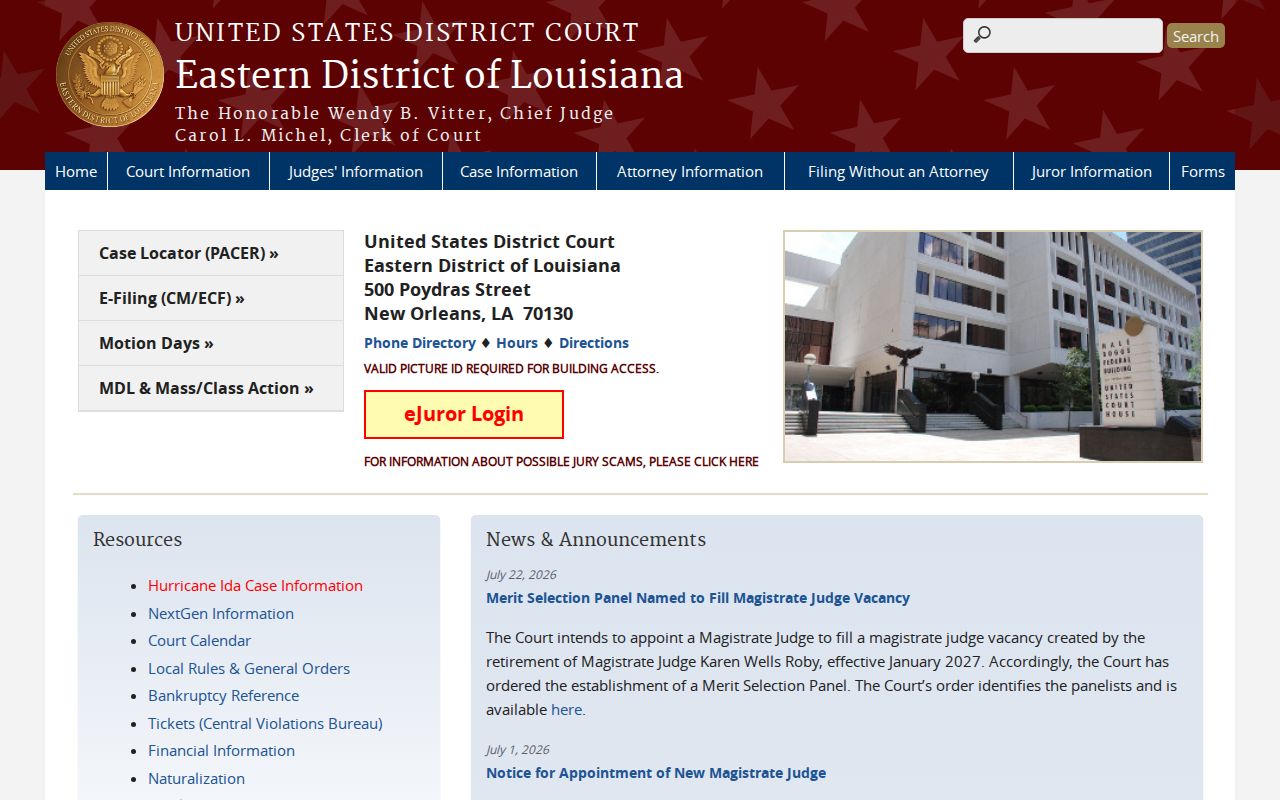
Federal PACER and CM/ECF records sit apart from the state and municipal docket paths in New Orleans.